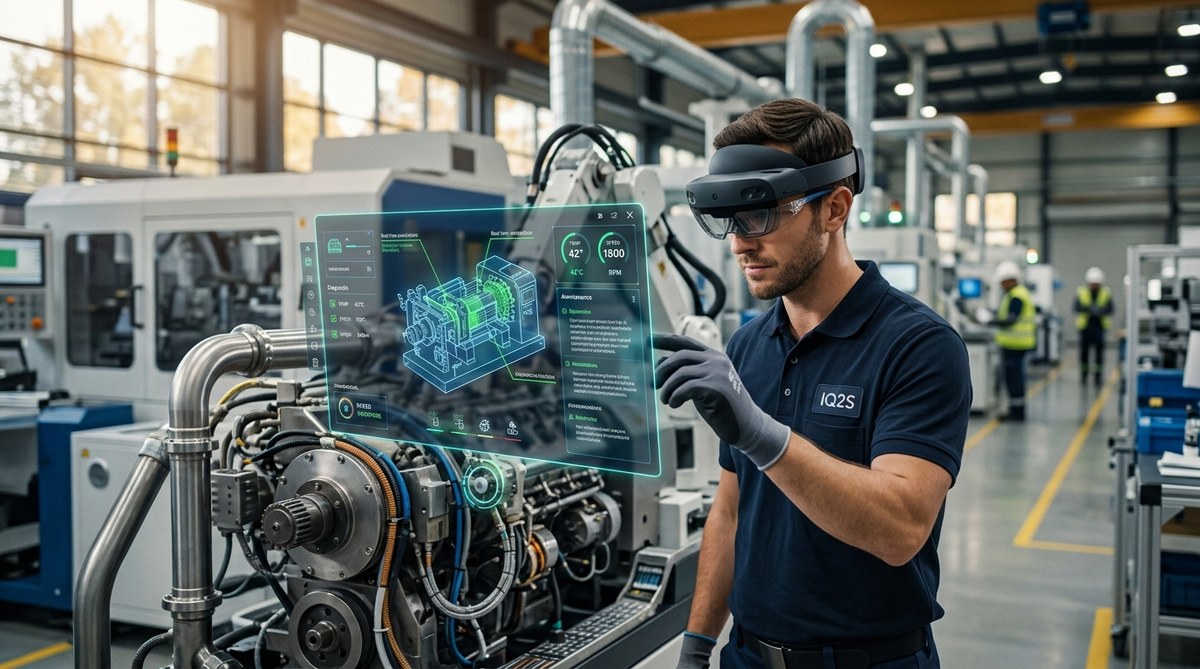
Augmented reality is no longer a sci fi concept confined to glossy press releases. It is a practical, efficient tool that blends the digital and physical worlds to improve how we work in industry. At IQ2S.org we are passionate about demystifying pervasive computing and emerging tech, and augmented reality is one of the most accessible ways to see tangible improvements on the factory floor, in the warehouse, or in the field. In this article we will explore concrete AR use cases across industries, the technology behind them, how to measure impact, and how to get started with confidence.
Understanding Augmented Reality in Industry
Augmented reality layers digital information onto the real world in real time. In industrial settings this usually means combining live video or camera feeds with computer generated graphics, text, or 3D models that users can interact with through smart glasses, tablets, or smartphones. The value of AR in industry comes from making information contextually available, reducing cognitive load, and enabling faster, more accurate decision making.
Key reasons AR resonates in industry
– Contextual guidance: workers see the exact steps, parts, or measurements at the moment they need them.
– Error reduction: real time validation helps prevent mistakes before they occur.
– Safer operations: AR can surface safety instructions and hazardous zones before a task begins.
– Faster onboarding: new hires reach productivity quicker by following guided work instructions.
– Remote expertise: remote experts can see what the worker sees and overlay assistance without being on site.
Top Use Case Categories for Augmented Reality in Industry
In the following sections we highlight major AR use case categories along with practical examples, benefits, and considerations for implementation.
Manufacturing and Assembly
AR shines in manufacturing where precision, speed, and standardization matter.
- Guided work instructions: technicians follow step by step overlays that align with the exact workstation and tools in use.
- Real time assembly validation: overlays confirm correct part orientation, torque, and connection points, reducing rework.
- Visualized bills of materials: digital parts lists appear in the operator’s field of view, helping with quick part verification.
- Quality control support: inspectors compare live measurements to digital models and capture evidence with context.
Practical benefits
– Increase first time yield and reduce scrap
– Shorten training cycles for new line operators
– Improve safety by reminding workers of protective measures in place
Implementation notes
1) Start with a single line or station and a measurable task.
2) Choose a hardware platform that fits the environment (glasses for hands free work, tablets for flexibility).
3) Integrate with your MES or ERP data so the AR overlays reflect current production data.
Maintenance and Field Service
AR accelerates maintenance through hands free guidance and remote support.
- Remote assistance: technicians wear AR gear while experts view the same scene and annotate fixes in real time.
- Step wise maintenance procedures: overlay checklists, torque specs, and sensor readings directly onto the equipment.
- Parts lookup and replacement instructions: identify the right parts and display replacement steps in context.
Practical benefits
– Reduce mean time to repair
– Lower travel costs by enabling remote access to expertise
– Improve maintenance quality and consistency across sites
Implementation notes
– Prioritize critical assets and high impact maintenance tasks for the pilot
– Use secure channels for remote sessions to protect sensitive equipment data
Training and Upskilling
AR speeds up onboarding by compressing knowledge transfer into immersive, repeatable experiences.
- Interactive training environments: trainees perform tasks with virtual overlays guiding correct technique.
- Safe practice in high risk settings: novices can rehearse complex procedures without risk to people or equipment.
- Knowledge capture: subject matter experts encode tacit knowledge into AR workflows that stay with the organization.
Practical benefits
– Shorter ramp times for new hires
– Consistent training across sites
– Better retention of standard operating procedures
Implementation notes
– Start with fundamental tasks and progressively add complexity
– Track learner progress with built in assessment checkpoints
Healthcare and Patient Care
In healthcare AR is increasingly used to support clinicians in surgery planning, anatomy education, and patient care workflows.
- Surgical planning and navigation: overlays help surgeons visualize anatomy and instrument trajectories during procedures.
- Procedures guidance: nurses and technicians receive step by step cues for complex tasks.
- Patient information visualization: AR visualizations help patients understand treatments or rehabilitation exercises.
Practical benefits
– Improved precision and outcomes for complex procedures
– Enhanced patient education and consent processes
– More efficient collaboration among multidisciplinary teams
Implementation notes
– Ensure strict compliance with patient data privacy
– Validate AR guidance with clinical trials and regulatory considerations
Logistics and Warehouse Operations
AR improves speed and accuracy in inventory management, picking, packing, and shipping.
- Pick by vision: overlays guide pickers to exact shelf locations and confirm picks.
- Real time inventory updates: wearable devices capture item status and location, updating systems on the fly.
- Cross dock and staging support: AR helps workers identify the correct routes and packaging requirements.
Practical benefits
– Higher order accuracy and faster throughput
– Reduced training burden for seasonal staff
– Better space utilization and flow visibility
Implementation notes
– Integrate with existing WMS and ERP to ensure data consistency
– Calibrate cameras and spatial mapping to warehouse lighting and layout
Construction and Architecture
AR supports design review, site planning, safety planning, and as built documentation.
- Design visualization on site: stakeholders can view proposed models aligned to real terrain and structures.
- Construction guidance: overlayed steps assist crews with installation, wiring, or structural assemblies.
- Safety and compliance overlays: hazards, PPE requirements, and plan deviations appear in context.
Practical benefits
– Reduced rework and miscommunication on site
– Earlier issue detection and risk mitigation
– Faster decision making during现场 coordination meetings
Implementation notes
– Tie AR experiences to BIM data and site GPS coordinates for accuracy
– Balance fidelity with device performance in outdoor environments
Energy and Utilities
AR supports maintenance of critical infrastructure, training of personnel, and remote diagnostics for plants and grids.
- Equipment diagnostics: live sensor data can be overlaid to guide troubleshooting.
- Routine inspections: checklists appear in the field of view and record evidence with location tags.
- Emergency response guidance: AR can direct crews to safety protocols during incidents.
Practical benefits
– Improved reliability and uptime of assets
– Safer inspection routines and reduced exposure to hazards
– Consistent maintenance documentation
Implementation notes
– Ensure robust offline capabilities for remote sites with limited connectivity
– Protect sensitive telemetry and asset data with strong security controls
Technology Enablers and Architecture
AR for industry relies on a mix of hardware, software, and data infrastructures. Understanding these components helps in selecting the right mix for your organization.
- Hardware and devices: smart glasses, rugged tablets, and wearable headsets are common; choose based on the environment, hands-free needs, and comfort.
- Software platforms: AR authoring tools, spatial computing engines, and device management frameworks enable content creation and delivery at scale.
- Edge vs cloud processing: edge devices handle real time overlays locally for latency critical tasks, while cloud services support content management, analytics, and large data processing.
- Computer vision and SLAM: robust tracking and spatial mapping ensure overlays align with the real world even in dynamic settings.
- Data security and privacy: encryption, access control, secure sessions for remote assistance, and compliance with industry regulations are essential.
Measuring Impact: ROI and KPIs
To justify an AR initiative, it is vital to define measurable outcomes before a pilot.
– Productivity gains: time saved per task, improved throughput, reduction in cycle times.
– Accuracy and quality: reduction in defects, fewer rework events, improved first pass yield.
– Safety metrics: near miss reductions, adherence to safety protocols, incident rates.
– Training outcomes: onboarding time, knowledge retention, competency levels after training.
– Asset utilization: uptime improvements, maintenance cycle optimization, and inventory accuracy.
– Cost of ownership: total cost of ownership including devices, software, maintenance, and support.
Implementation Roadmap and Best Practices
A pragmatic approach helps maximize value while reducing risk.
1) Define a problem with a measurable outcome: pick a task that is repeatable and has a clear improvement potential.
2) Build a cross functional team: include operations, IT, safety, and frontline workers to capture diverse perspectives.
3) Start with a pilot on a single line or site: limit scope to learn quickly and iterate.
4) Choose focused use cases first: avoid trying to solve everything at once.
5) Align data sources: ensure AR overlays reflect correct, up to date information from your systems.
6) Pilot hardware in the actual work environment: account for lighting, noise, and mobility.
7) Establish a measurement plan: decide on KPIs, data collection methods, and a timeline for review.
8) Plan for scale: design the solution with reusability in mind and create a content management strategy.
9) Address change management: communicate benefits, provide training and support to users.
10) Ensure security and compliance: implement secure access, data handling, and audit capabilities.
Common Challenges and How to Mitigate Them
- High upfront costs: start small with a single use case, then demonstrate ROI to justify expansion.
- Integration complexity: choose AR platforms with open APIs and straightforward integration with existing ERP, MES, and WMS systems.
- Content creation bottlenecks: invest in reusable, modular AR assets and a scalable authoring workflow.
- User adoption: involve frontline workers early, provide hands on training, and highlight tangible benefits.
- Data security concerns: implement device authentication, encrypted sessions, and controlled data access policies.
- Maintenance and updates: define a content governance process to keep overlays current and accurate.
Real World Examples and Scenarios
- Hypothetical case: A global manufacturing plant piloted AR guided work instructions for a critical assembly task. Over six months, first pass yield improved from 92 percent to 97 percent, and onboarding times for new operators dropped from two weeks to five days. The project required minimal changes to existing workflows and integrated with the plant’s existing MES data to present real time metrics within the overlay.
- Hypothetical case: A logistics hub deployed AR pick by vision across three teams. Through the pilot, order accuracy rose from 99.2 percent to 99.9 percent and the line throughput increased by 12 percent during peak season, with remote support available for complex picks.
- Hypothetical case: A field service company used AR remote assistance to service a fleet of industrial pumps. Remote experts could annotate in real time and guide technicians to perform a precision alignment. The time to repair decreased by roughly 30 percent compared to on site only support, reducing downtime for critical equipment.
Future Trends and Next Frontiers
- Deeper integration with AI: AR systems that interpret sensor data and offer prescriptive guidance will become more common.
- Spatial collaboration at scale: multi user AR experiences will enable teams across locations to work together in a shared augmented workspace.
- More resilient edge compute: on device processing will reduce latency and enable AR in environments with poor network connectivity.
- Personalization and adaptive overlays: AR content can adapt to the user’s role, skill level, and learning style.
- Industry specific ecosystems: sector oriented AR content libraries and plug and play workflows will accelerate time to value.
How IQ2S.org Weaves AR into the Emerging Tech Narrative
Augmented reality is more than a gadget or flashy demonstration. It is a practical layer that, when applied thoughtfully, drives measurable improvements across engineering, operations, and maintenance. At IQ2S.org we emphasize approachable tutorials, clear ROI thinking, and practical guidance for deploying AR in real world industrial settings. Our aim is to help practitioners understand not only what AR can do, but how to do it well, including integration with other pervasive technologies like IoT, WebSockets for real time data, MQTT connectivity, and secure edge processing.
Practical Steps for Your Organization
If you are considering AR for your factory, warehouse, or field service team, here is a compact starter guide:
- Step 1: Choose a high impact use case with a clear success metric (for example reduce rework by 20 percent in a specific assembly line within three months).
- Step 2: Map data sources and ensure synchronized, reliable information feeds that will be overlaid.
- Step 3: Select hardware that fits the environment and the task (hands free where possible, durable devices for outdoor sites).
- Step 4: Develop a minimal viable AR workflow with a few key overlays and a simple content authoring process.
- Step 5: Run a controlled pilot, collect quantitative and qualitative feedback, and refine.
- Step 6: Create a plan to scale, including content governance, training, and change management.
Key Takeaways
- Augmented reality translates digital knowledge into actionable on site guidance that reduces errors and speeds up work.
- The strongest AR use cases are those that tie directly to critical tasks, safety, and onboarding.
- A careful, staged approach to implementation minimizes risk and maximizes return on investment.
- Security, interoperability, and data integrity are foundational concerns that must be addressed early.
Final Thoughts
AR use cases in industry are not about technology for technology’s sake. They are about empowering people to perform better, safer, and more consistently. The right AR solution blends hardware we can wear or carry comfortably, software that is easy to create and manage, and data infrastructure that keeps information timely and secure. If your organization is exploring how to bring AR into everyday operations, start with a concrete problem, design a pilot that can be measured, and build a scalable plan from there. The payoff is not just faster tasks or fewer errors; it is a more capable workforce empowered by real time, context aware intelligence.
Appendix: Quick Reference Checklist
- Target area: factory floor, warehouse, or field service
- Primary metric: productivity, accuracy, safety, or onboarding time
- Hardware considerations: hands free, rugged, battery life, comfort
- Data integration: ERP, MES, WMS, sensor data
- Security: device authentication, encrypted sessions, access controls
- Pilot scope: one task, one shift, one site
- Scale plan: content management, governance, and ongoing training
- Change management: stakeholder engagement and clear communication
If you are ready to explore AR use cases in your industry, IQ2S.org is here to guide you. We can help you map your objectives to practical AR workflows, identify the right hardware and software mix, and design a pilot that demonstrates real value quickly. The future of industrial work is augmented, and the opportunity to improve outcomes is within reach.
No Responses